
Japan’s farmed “salmon” sector grows amid higher airfreight costs for fresh imports
By Chris Loew • Published: June 2, 2026
Japan’s farmed “salmon” sector grows amid higher airfreight costs for fresh imports
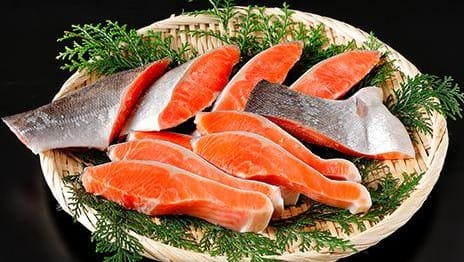
Japanese-produced salmon is moving from a regional specialty to a larger procurement option for supermarkets, sushi chains and seafood distributors.
Domestic farmed salmon production is expected to reach a record 33,000 to 34,000 metric tons (MT) in 2026, according to a Nikkei report citing Satoshi Imai, a senior researcher at the Japan Fisheries Research and Education Agency. That would still leave Japan heavily dependent on imports, but it marks a shift in a market where local production was once limited to small seasonal brands.
The expansion is being helped by higher import costs, yen weakness, and buyers’ desire for more predictable fresh supply. The word “salmon,” however, is interpreted loosely in Japan to include not only Atlantic and coho salmon, but also trout species like rainbow trout and cherry salmon, or sakuramasu. For English-speaking readers, that distinction is important: Japan’s domestic salmon boom is not one species, one production model or one market.
The market for imported salmon is segmented in Japan. Norwegian Atlantic salmon is generally flown fresh to Japan for raw consumption in sushi and sashimi. Chilean salmon, by contrast, is usually frozen coho used for kirimi—sliced fish portions, typically used for grilling. Because these products move through different supply chains and are used in different ways, the pressures on Norway and Chile differ.
Norwegian salmon’s vulnerability is air logistics. Fresh salmon must move quickly, and exports to Asia have depended on long-haul air cargo capacity and routes through Persian Gulf states, but airspace closures have required rerouting. In April, the Norwegian Seafood Council said, “The war in the Middle East has been particularly challenging for salmon exporters due to increased fuel costs and changes to air freight routes.” That does not mean domestic Japanese salmon can replace all Norwegian Atlantic salmon, but it strengthens the case for local fresh supply when airfreight becomes expensive or unpredictable.
Chile faces a different set of issues. Chilean producers mainly ship frozen coho salmon by sea, making them far less exposed to air-cargo disruption. They instead face recurring concerns over disease, antibiotic use, environmental scrutiny, protected areas and density restrictions. For Japanese buyers, Chile remains important for everyday frozen salmon portions, while domestic Japanese producers are trying to build higher-value niches around fresh seasonal salmon, local-brand trout and coho, and land-based Atlantic salmon.
The main biological problem for Japanese salmon farmers is temperature. Salmonids are cool-water fish, while much of Japan’s coastal water becomes too warm in summer. Sea-based producers have generally solved this by farming through the cooler months and harvesting before summer temperatures rise. This gives Japan a spring-to-early-summer domestic salmon season, but it also limits year-round supply and produces smaller fish.
Miyagi Prefecture, in northeastern Honshu, is the center of this seasonal sea-farmed model. Its farmed coho, marketed as Miyagi Salmon, is Japan’s largest domestic salmon production cluster, with Nikkei reporting expected 2026 production of about 15,000 MT. The product benefits from scale, local branding and established distribution through wholesale markets, supermarkets and restaurants. Nikkei reported that Okamura Foods expects 2026 production of about 4,300 MT, up 20 percent year on year. The company has helped move domestic farmed trout from a regional novelty toward a larger sushi and sashimi product, although it still operates within the seasonal constraints of Japan’s northern coastal waters. Situated between Aomori and Miyagi, Iwate Prefecture has several local brands, including products differentiated by feed ingredients or local identity.
Also relying on a seasonal grow-out strategy is Nissui Corporation, based in Tokyo. The company’s subsidiary, Nissui Salmon, based in Sakaiminato, Tottori Prefecture, operates farms in Tottori, Niigata and Iwate prefectures and sells brands including Sakaiminato Salmon and Sado Salmon. Nissui plans to increase production to 10,000 MT by 2030, about 2.5 times its 2025 level, by adding larger sea cages and expanding land-based juvenile facilities. The company’s advantage is not only farming capacity but also processing, branding and national seafood distribution.
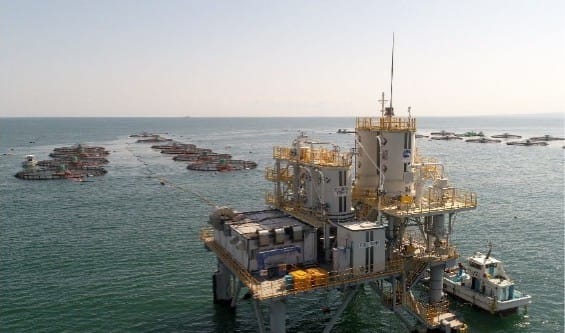
Nissui’s Sakaiminato operation also shows how automation is being used to address the labor and scale challenges of sea farming. Materials from the Japan Fisheries Research and Education Agency describe a highly automated farm based around a steel platform that holds feed. This kind of infrastructure is part of the reason large seafood companies may be better placed than small local producers to turn seasonal salmon into a more dependable national supply category.
Two large land-based Atlantic salmon projects represent a different strategy. Instead of working around Japan’s warm summers by harvesting early, they aim to control the growing environment and supply fresh Atlantic salmon domestically. Proximar Seafood’s Fuji Atlantic Salmon facility in Oyama, Shizuoka Prefecture, uses local groundwater and AquaMaof recirculating aquaculture system (RAS) technology at a site near Mount Fuji. The project gives Japan a year-round domestic source of true Atlantic salmon, placing it closer to Norwegian fresh salmon than to seasonal coho or trout brands.
Earlier project materials used the phrase “Soul of Japan,” but the product launched commercially as "Fuji Atlantic Salmon." The name reflects both the location and the effort to position the fish as a domestic alternative to airflown Atlantic salmon. Proximar says its system is designed to reduce energy use through features such as gravity-led aeration and trickling biofilters, while using local groundwater.
The ramp-up has been difficult. Proximar’s first full commercial year remained far below its long-term target of 5,300 MT per year on a head-on, gutted (HOG) basis, with the company reporting 1,338 MT harvested in 2025. It harvested 321 MT HOG in the second quarter of 2025, bringing first-half harvest to 643 MT, and later reported 339 MT in the fourth quarter. The company has also faced biofilter-related growth issues, lower-than-target harvest weights, cash-flow pressure and a May 2025 mortality incident that reduced the survival rate reported in the quarter’s figures.
ATLAND, in Nyuzen, Toyama Prefecture, offers a second land-based Atlantic salmon model. The joint venture between Mitsubishi Corporation and Maruha Nichiro (now renamed as "Umios"), both based in Tokyo, is described as a RAS facility, but its site advantage is access to cold deep seawater from Toyama Bay and clean groundwater. ATLAND combines recirculating technology with a naturally cold water source, reducing a typical burden faced by land-based farms of controlling temperature mechanically. Like Proximar, it is positioned as a domestic source of Atlantic salmon, but its water strategy and regional setting are different.
For Japanese seafood buyers, the domestic salmon market is segmented. Seasonal coho and trout from Miyagi, Aomori, Tottori, Niigata and Iwate give buyers a fresh domestic salmon option during the spring-to-summer harvest window, especially for sushi, sashimi and prepared seafood counters. Land-based Atlantic salmon from Shizuoka and Toyama is more directly positioned against fresh Norwegian Atlantic salmon. Local production also gives retailers a domestic-origin story, shorter transport time and potentially greater resilience against currency and logistics shocks.
Domestic production remains small compared with global Atlantic salmon output, but unstable logistics for Norwegian product and the weak yen are helping these smaller players to carve out their own niches in the market.