Aeon joins first trial sales of closed-cycle farmed unagi
By Chris Loew • Published: May 29, 2026
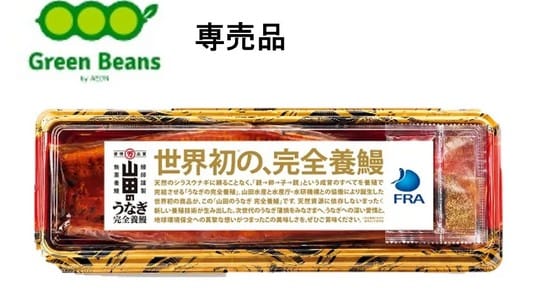
Japan’s first trial sales of fully closed-cycle farmed eel began May 29 through channels including retailer Aeon’s online platforms and eel producer Yamada Suisan’s sales channels, marking what the companies describe as the world’s first general-consumer trial sale of grilled eel produced entirely from fish bred in captivity.
The products are made from Japanese eel (Anguilla japonica) raised without reliance on wild-caught glass eels. Aeon is selling Yamada Suisan’s “Yamada no Unagi Kanzen Yo-man” Kagoshima Prefecture fully farmed unagi kabayaki through its Green Beans online supermarket and Aeon Shop, while Yamada Suisan is selling through its official online shop and Tsukiji store. Sales through Nihombashi Mitsukoshi’s Food Collection are planned for July.
Aeon’s May 28 press release lists Green Beans products at JPY 4,860 to JPY 5,940 including tax, depending on size. Aeon Shop gift boxes are listed at JPY 10,584 for two eels totaling 228 grams and JPY 12,960 for two eels totaling 360 grams. At current exchange rates, the JPY 9,720 price cited in earlier Japanese media coverage is approximately USD 61.00 or EUR 52.38.
Yamada Suisan said sales through its online shop and Tsukiji store would begin on May 29, with sales ending once planned quantities are reached. A separate Yamada Suisan notice said the Nihombashi Mitsukoshi sales would be held in July, with details to be announced later.
The trial is small. Japanese media reported that the initial sale would involve about 600 eels. That is negligible compared with Japan’s overall eel market, which relies heavily on both domestic aquaculture and imported processed eel products.
Approximately 60% to 70% of Japan’s annual supply of unagi kabayaki comes from imports, while domestic production accounts for the remaining 30% to 40%, according to Japanese eel fisheries statistics published by the Fisheries Research and Education Agency (FRA). China dominates imported supply, accounting for roughly 90% of imported eel products, particularly prepared kabayaki, while Taiwan supplies most of the remainder, according to trade analyses examining Japan’s eel supply chain.
Imported products also include multiple eel species. Although products may be processed and exported from China, DNA barcoding studies examining global eel supply chains have shown that Chinese farms raise multiple eel species sourced internationally as juveniles, including Japanese eel (Anguilla japonica), American eel (Anguilla rostrata), and smaller quantities of European eel (Anguilla anguilla).
Japan’s eel industry has long depended on wild glass eels, even when the final product is farmed. Juvenile eels are collected from rivers and coastal waters, then transferred to grow-out ponds. The supply is highly variable, and resource declines have increased pressure on eel producers, retailers, and regulators. Japanese eel was listed as endangered by the International Union for Conservation of Nature in 2014. European eel is listed as critically endangered, and trade restrictions have affected its use in international supply chains. American eel has also been used as a substitute in East Asian aquaculture and processing.
Aeon has positioned eel procurement as part of its wider sustainable seafood strategy for years. In a 2018 eel handling policy, the company said it aimed to sell 100% traceable eel by 2023, promote resource management efforts for Indonesian shortfin eel, and develop kabayaki-style products using ingredients other than eel. The company also noted in the 2018 policy that Japanese eel and Indonesian shortfin eel were its two main eel items, while European eel and American eel would not be procured or sold. The policy was part of Aeon’s broader sustainable procurement goals for agricultural, livestock, fishery, paper, pulp, timber, and palm oil products.
The current trial sale is linked to government-backed closed-cycle eel research led by FRA. Aeon said it is participating as a cooperating company in a demonstration project aimed at social implementation of fully farmed eel technology. According to Aeon, FRA has been conducting research and development on complete eel aquaculture since the 1990s. In 2010, Japanese researchers succeeded in spawning eels using broodstock raised from artificially collected eggs, an important step toward closing the breeding cycle. Since then, the work has focused on improving rearing technology and production systems.
The technical problem has not been ordinary grow-out. Eel farmers have long known how to raise glass eels to market size. The much harder problem is producing glass eels in the first place.
Eel larvae are fragile, slow to develop, and difficult to feed. They require specialized diets, carefully controlled water quality, and intensive husbandry. Uneaten feed and waste must be removed without damaging the larvae, and the larvae must survive long enough to metamorphose into transparent glass eels suitable for conventional aquaculture systems.
FRA’s Glass Eel Production Division describes its work as including development of large-scale tanks, automatic feeding systems, mass production systems, and technologies to improve survival and production efficiency.
Yamada Suisan’s role appears to combine participation in the social implementation project with grow-out and processing. In the current trial, fully farmed eels were grown to market size by Yamada Suisan and processed into kabayaki. Earlier cooperation between Yamada Suisan and FRA dates back years, including grow-out experiments using artificially produced glass eels. Yamada Suisan is a major domestic eel producer. Its English company profile says it raises about 1,000 metric tons of eels annually at five eel farms in Kagoshima Prefecture.
Cost reduction has been central to the move from research toward trial sales. Japanese reports have said the cost of producing one artificial glass eel exceeded JPY 1 million in early research stages, fell to around JPY 40,000 by 2016, and has since declined to roughly JPY 1,800. Even at that level, artificial glass eels remain more expensive than wild-caught juveniles.
The price of the trial products reflects that gap. Aeon’s listed products range from JPY 4,860 for a 131-gram single-eel pack to JPY 12,960 for a two-eel gift box totaling 360 grams. The products are therefore positioned closer to premium or gift-market channels than conventional supermarket eel promotions.
Aeon said purchasers will be asked to cooperate with a questionnaire, and that feedback from the trial sale will be reflected in future work on the project.